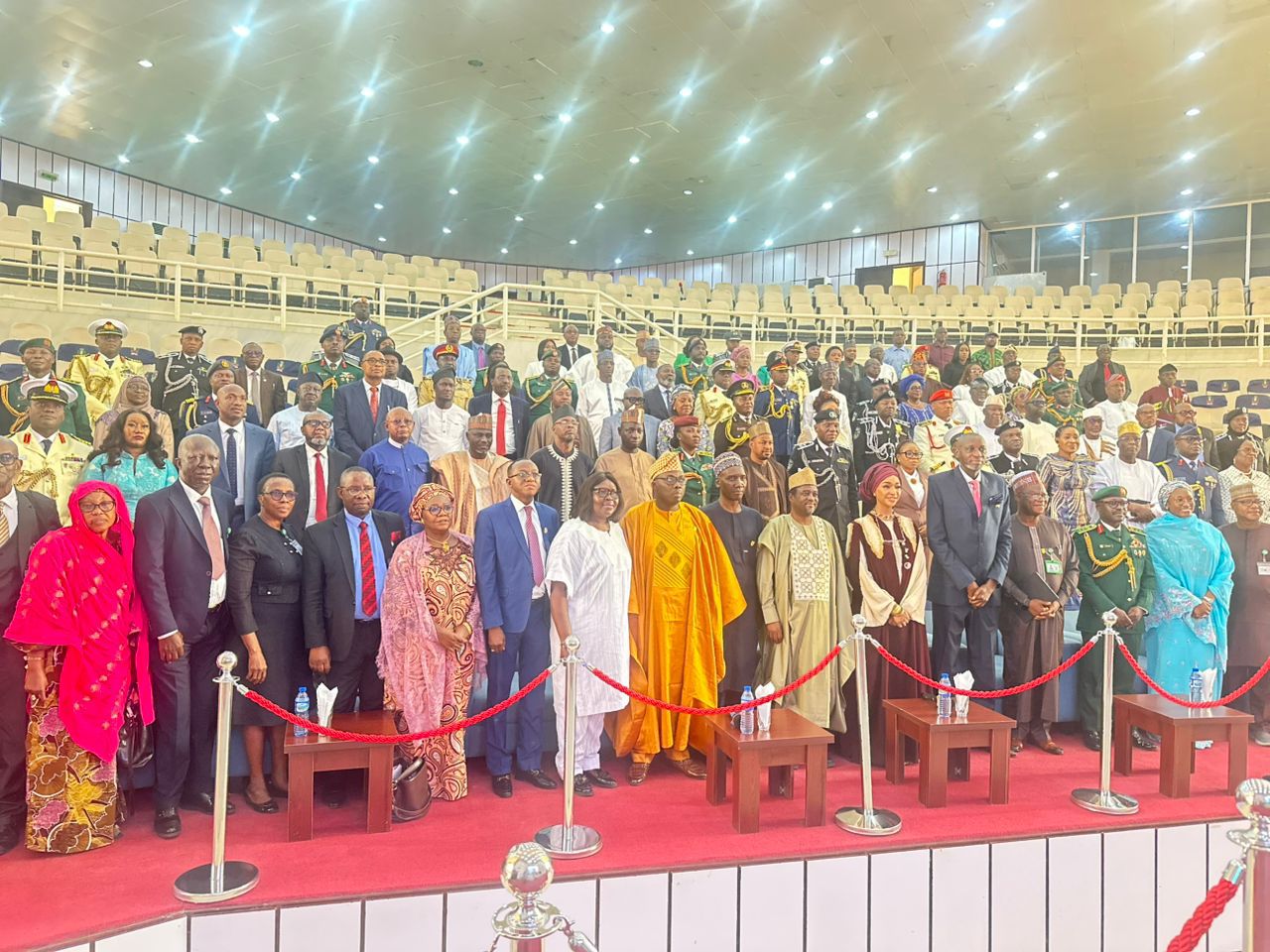
National Institute for Policy and Strategic Studies today hosted the Honourable Minister of Art, Culture, Tourism and the Creative Economy, Hannatu Musa Musawa, who delivered the inaugural lecture to participants of the Senior Executive Course (SEC) 48, 2026, charging them to rethink national development through the lens of the Orange Economy.
Delivering a lecture titled “Maximising the Orange Economy and Entrepreneurship for Sustainable Growth in Nigeria,”the Minister framed the creative economy as a strategic national asset capable of generating large-scale employment, boosting GDP, and repositioning Nigeria as Africa’s cultural and creative capital.
Drawing on the Inter-American Development Bank’s conception of the Orange Economy as activities that transform creative ideas into cultural goods and services with economic value, Musawa highlighted that the sector accounts for over 30 million jobs globally and contributes more than 3 per cent to global GDP. She noted that Nigeria already commands about 15 per cent of Sub-Saharan Africa’s $31 billion creative economy, underscoring its latent potential.
The Minister situated the creative economy within Presidential Priority Area 7, which seeks to accelerate diversification through industrialisation, digitisation and creative arts. She emphasised that Nigeria must move deliberately from celebrating talent to building systems that can industrialise creativity at scale.
In benchmarking Nigeria’s ambition, Musawa referenced the transformation strategies of countries that have successfully leveraged culture and tourism for economic growth.
Saudi Arabia’s use of its Public Investment Fund and the establishment of a $4 billion Tourism Development Fund, alongside dedicated cultural funds and a 40 per cent cash rebate for film productions, she pointed to measurable impact: double-digit tourism contribution to GDP and millions of jobs in travel and tourism. Tourism GDP rose sharply between 2022 and 2024, meeting the country’s 2030 target ahead of schedule.
She also highlighted South Korea’s government-backed funding ecosystem, including robust ministry budgets and content funds that have propelled K-pop, film and digital exports. The country’s cultural products export revenue reached over $12 billion in 2024, with 600,000 people employed in the creative sector .
Further lessons were drawn from Egypt and Morocco, both of which combined heritage investment, sovereign-backed tourism funds and targeted film incentives to expand the contribution of culture and tourism to GDP while increasing employment.
Turning to Nigeria, the Minister referenced findings from the national Creative Economy Mapping Report, which projects the potential creation of 2.58 million new jobs and a $100 billion GDP contribution by 2030 under an ideal scenario. Even under conservative estimates, over 769,000 jobs could be generated.
She identified persistent challenges confronting the sector, including weak domestic monetisation, infrastructure deficits, piracy and weak intellectual property enforcement, limited access to finance, and skills gaps.
To address these constraints, Musawa unveiled the Nigeria Destination 2030 Framework, an eight-point plan designed to increase the sector’s GDP contribution by $100 billion and create two million jobs by 2030. The framework rests on strategic pillars such as technology, infrastructure and funding, international cultural promotion, and intellectual property monetisation, supported by regulatory clarity, capacity development and strategic branding.
She outlined a phased roadmap: establishing foundational investment vehicles and copyright reform; scaling infrastructure and talent pipelines nationwide; and ultimately consolidating the sector through integration into urban planning, cultural diplomacy and advanced technologies such as AI, VR/AR and blockchain for intellectual property management.
The Minister disclosed actions already underway, including the Creative Economy Development Fund supported by Afreximbank, the Renewed Hope Hubs initiative with French Treasury backing, landmark infrastructure projects, copyright reform processes, and digital platforms aimed at formalising and monetising Nigerian content.
She also explained the establishment of the Creative and Tourism Infrastructure Corporation (CTICo), wholly owned by the Federal Government through MOFI, to invest alongside the private sector via public–private partnerships, grants and fund-of-funds structures.
Highlighting sectoral opportunities, Musawa identified fashion, film, music, leather and tanneries, garment manufacturing, and emerging technologies such as animation and gaming as top job-creation drivers, stressing that the creative economy is not confined to Lagos but spans all six geopolitical zones.
She pointed to recent global milestones as proof of concept, including international investment in Nigerian music labels, Nollywood’s market dominance in West Africa, Grammy recognition for Afrobeats, and significant royalty payouts to Nigerian artists in 2024.
Concluding her address, the Minister urged SEC 48 participants to view the creative economy not as an adjunct sector but as a core pillar of national strategy. Industrialisation, she argued, must shift the sector from informal hustle to structured, investible enterprises capable of delivering dignified jobs and sustainable growth.
“The time to unlock the full power of Nigeria’s creative economy is now,” she declared, setting the tone for what promises to be a policy-driven engagement between Nigeria’s top executives and one of the country’s most dynamic growth frontiers.