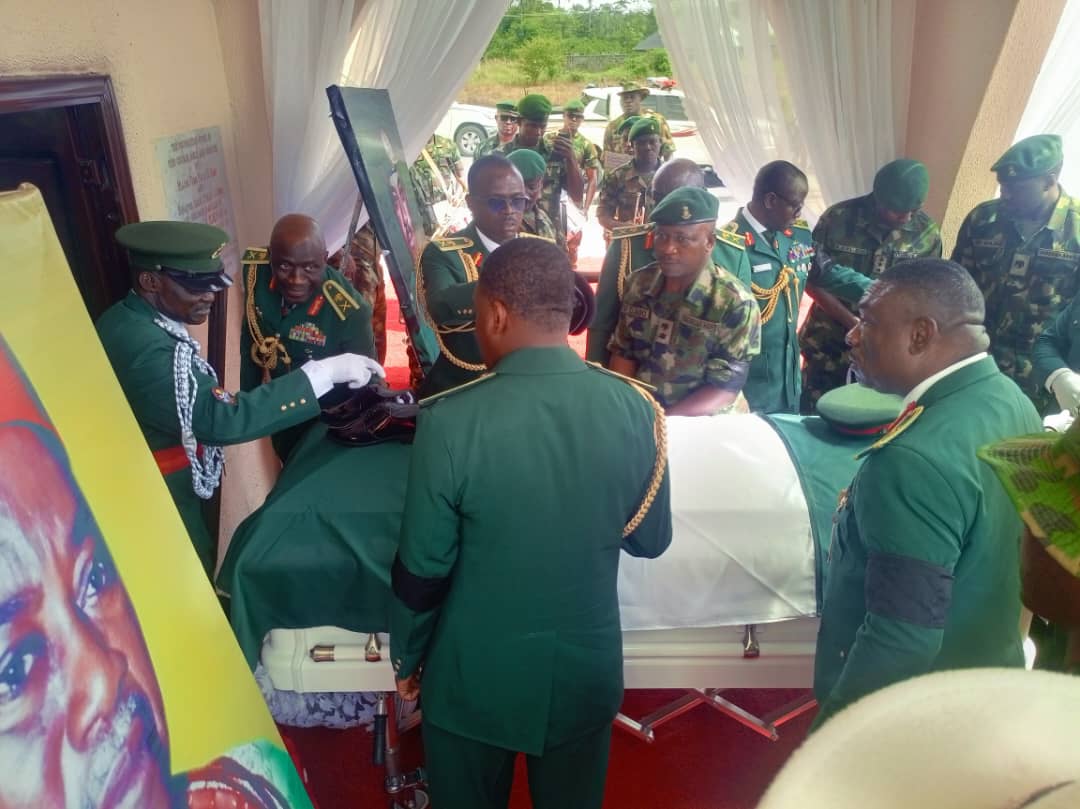
Major General Paul Ufuoma Omu, fss, reds (rtd) was born at Igbide in Isoko Local Government Area of Delta State on July 1st, 1940. After his secondary education (1955-59) and his GCE ‘A’ level (1961/62) he joined the Nigeria army as an officer-cadet in December 1962. Training briefly at the then Nigeria Military Training College (NMTC) Kaduna, he proceeded to the MONS Officer-cadet School, Aldershot, UK where he obtained his commission as 2/Lt in July 1963.
He served the Nigeria Army in several capacities, rising to command 33 infantry Brigade Maiduguri (1974-75), 3 Mechanised Infantry brigade, kano (1983), Commandant, Command and Staff College (1984-88) and on the staff, Director, Army Staff Duties and plans (1978/79); Military Secretary (Army) (1979-81); Principal Joint Staff Officer Ministry of Defence (1988-89) and Chief of the Nigeria delegation to the International military Sports Commission (1984-88).
His flair for military law had put him among Nigeria’s representatives at the British Commonwealth–composed military tribunal in Trinidad and Tobago, West Indies (February-June 1971). He probably headed the 1st Special military tribunal for the recovery of Public Property at the time, a very sensational and sensitive exercise. He was Chairman of the Armed Forces Ruling Council Committees on (1) The Draft Government White paper on the Political Bureau report that ushered in the transition to Civil Rule Programme and (2) Guidelines on the utilization of the 1.5% Fund for the development of Mineral Producing Areas and the 1% Fund on the Amelioration of Ecological Problems nationwide. He is a member of the prestigious Royal College of Defence Studies London, which he attended in 1982.
Extra -regimentally, he was Military Governor, Cross River State (1975-78) and a member of the Supreme Military Council/Armed Force Ruling Council 1984-89). He was the pioneer chairman of Armed Forces Consultative Assembly, 1989.
He was a Director–General of the National Institute for Policy and Strategic Studies, Kuru, between January 1990 till 1992, and also, as a board chairman after his retirement, he voluntarily retired in 1990. Gen Omu while at NIPSS achieved the following to his credit.
(a) He completed buildings for Director–general and Directors and eight 4-bedroom houses abandoned at foundation level since 1979
(b) Changed roofs of staff and participate accommodation to long span aluminium sheets to forestall perennial leakages during rainy season
(c) Building of NIPSS Medical Centre
(d) Building Renovation of road from NDA Base Camp at Angudi to NVRI Vom through Federal Ministry of Works and Housing.
(e) Building the two NIPSS synthetic lawn tennis courts
Above all, Gen Omu is a keen sportsman and organiser, playing squash and lawn tennis, Photography and film-making are his serious hobbies. He travelled widely and was married with children.